.png)

Rhythmic Movement
Therapy
How Did I Get Here?
I happened to be listening to Chris Evans on the radio, talking about some learning challenges his son was facing and immediately related; he was describing my daughter to a tee. He spoke about this ‘revolutionary’ therapy to integrate retained, primitive reflexes that had completely changed his son’s life, improving his reading, writing and social skills. I needed to know more!
With no practitioners nearby, and a 3-year wait for my daughter’s autism referral, I enrolled on a weekend Rhythmic Movement Therapy (RMT) course to teach myself, initially with a view to just helping my daughter and just doing the one course. After one day of training, I realised I needed to know more, and that this therapy and learning was too important not to share.
SEN support is becoming increasingly harder to access, referrals are taking years, children are falling years behind in school, and schools and SEN services are themselves overwhelmed. RMT is not a quick fix, it is not a pill you can take, and it requires consistency, but my goodness, it really can be revolutionary!
Retained Reflexes – What are they?
Reflex movements are the first foundations of the nervous system. We are born with primitive reflexes for survival – these aren’t meant to stay. As we move, these reflexes become learned, or integrated, allowing us to move on ready for our next developmental stage. These primitive reflexes should ideally be fully integrated by the age of 18-24 months. However, if they don’t integrate on time, children are ‘stuck’ in survival mode (reflexes are ‘retained’) and might exhibit difficulties with physical coordination, emotional regulation, attention, sensory processing or academic performance. The child is trying so hard to fill up their developmental learning bucket, which isn’t possible because the foundational holes (primitive reflexes) haven’t been plugged (integrated).
The great news is, the brain can change! With the right input, the body can unlock, the nervous system can become calmer, and your child can emerge from their sense of hibernation to experience a bright, new spring of attaining their true potential.
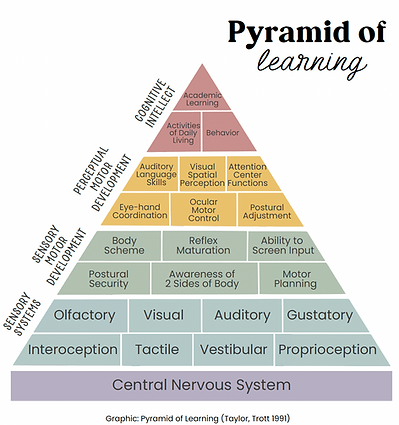
Pyramid of Learning – this Pyramid of Learning (Taylor, Trott 1991) shows the building blocks for a calm and balanced child, ready to learn. If some of the blocks are missing (unintegrated), achieving the apex becomes so much harder and more exhausting.

Rhythmic Movement Therapy (RMT)
what is it?
Movement builds the foundations for the brain – it’s where learning begins, and ultimately allows children to focus, communicate and learn.
RMT is a person-centred, movement-based programme that follows the body’s natural developmental process, to help overcome physical, emotional and learning challenges. By stimulating and mimicking a baby’s natural movement pattern, each movement builds a new neural pathway. These are small, gentle movements, the repetition of which helps to build and strengthen the pathway; through this, the brain learns, adapts, integrates the primitive reflex and ultimately allows the body to move on through its developmental stages. Like a balm to the nervous system.
The brain needs a clear sense of where the body is in space, which starts with a strong core, good posture and balance. This supports focus & attention, coordination, emotional regulation, fine motor skills, confidence and learning readiness.
Gut-Brain Axis - What is it?
Ever had that ‘gut feeling’ about something, or feeling sick because of an upcoming test/presentation? The Gut-Brain Axis is the connection between your digestive tract and your central nervous system. The vagus nerves sends signals from the brain to the gut in both directions, influencing your digestion, emotional regulation and cognitive function. 90% of serotonin (the ‘happy’ hormone) is made in the gut. So, feeding the body with the right nutrients keeps the healthy bacteria happy, positively influencing the brain’s ability to learn, regulate and deal with stress. The right nutrients, combined with the right movements, ensure a happier and more balanced brain and body.
Best way to keep the gut microbiome happy? Eat plenty of fibre, cut down on sugar and eat your rainbow.

Who is RMT
for?
I work predominantly with children (0-16) with learning, emotional or social challenges. The earlier we are able to start working on integrating reflexes, the quicker the results, as those neural pathways are still young. Issues could include, but are not limited to:
ANXIETY
-
PHOBIAS & FEARS
-
POOR DEXTERITY
-
POOR POSTURE
-
SLEEP DIFFICULTIES
-
COORDINATION DIFFICULTIES
-
POOR MEMORY
-
BED WETTING
-
CONCENTRATION
-
HYPERACTIVITY
-
TOE WALKING
-
DYSPRAXIA
Reflexes can also be thrown back into ‘primitive survival mode’ due to trauma or illness, and RMT, together with good nutrition, can also benefit adults with, for example, PTSD, Parkinsons, anxiety.

What might some signs of Retained Reflexes be?
Behavioural: Lack of focus, fidgety, aggressive, impulsive
Motor: Poor balance, poor coordination, poor posture, toe walking, bed wetting, poor manual dexterity
Visual: Difficulty reading, unable to maintain eye contact, unable to track
Auditory: Inability to follow instructions, inability to filter out noise, blurts out comments, communication issues
Emotional: Hyper sensitive, hyper reactive, impulsivity, emotional immaturity, anxiety, phobias
Sensory: Light sensitivity, sound sensitivity, food sensitivity, clothes tags irritate, chews clothes